
natto-adv
The Food Missing From Every Western Diet — And Why Japan’s Hearts Have Outlasted Ours for a Thousand Years
I spent five years buying beetroot, garlic capsules, fish oil, and CoQ10. My numbers never moved. Then I learned what the Japanese have been eating every morning since before modern medicine existed.


I found the beetroot powder at the back of the cabinet last Tuesday. Behind the garlic capsules I stopped opening in March. Behind the CoQ10 that cost forty-two dollars and tasted like I was chewing on a tire.
Five bottles. Five different labels. Five different promises about my heart, my circulation, my blood pressure, my “cardiovascular wellness.” I had been swallowing them every morning for the better part of three years, lining them up on the counter next to my coffee like a small, expensive ritual of hope.
My numbers never moved. Not once.
I know this because I have a blood pressure cuff on the nightstand and I use it the way some people check their phone — first thing in the morning, last thing at night, and once in between when the tightness in my chest reminds me it’s there.
Tom — my husband — had his scare two years ago. Nothing dramatic. Just numbers his doctor didn’t like, a conversation we weren’t ready for, and a drive home where neither of us said anything for eleven minutes. I counted.
After that, I became the person in the family who reads labels. Who Googles ingredients at midnight. Who spends twenty minutes in the supplement aisle comparing milligrams and wondering why none of it ever seems to do what the bottle says it will.
Nobody told me I was buying the wrong thing.
Not the wrong brand. The wrong category entirely.

The Symptoms You Think Are “Just Aging” — Aren’t
Do any of these sound familiar?
-
You climb a flight of stairs and feel a tightness across your chest that wasn’t there two years ago
-
Your hands and feet are cold most of the time, even in a warm room, and you’ve stopped mentioning it
-
You wake at 2 a.m. with your hand on your chest, counting heartbeats, wondering if tonight is the night
-
Your blood work comes back “normal” and you walk to your car feeling anything but relieved
-
You’ve added a statin, cut the sodium, increased the walks — and the reading on the cuff stays stubbornly the same
-
You used to have energy at 4 p.m. Now you sit in the car for a few minutes before walking inside, and you don’t know why
I had every one of these. Every single one. And I thought it was just what happens after fifty-five.
It isn’t.

The Protein Nobody Told You About — and Why Your Supplements Can’t Touch It
Here is what I learned at midnight on a Tuesday, sitting at the kitchen table with my laptop open and a cold cup of tea I’d forgotten to drink.
There is a protein inside your blood vessels called fibrin. When you’re young, fibrin does exactly what it’s supposed to — it forms a mesh over wounds to stop bleeding, and then your body breaks it down and clears it away.
After forty, that cleanup system starts falling behind. An enzyme called tPA slows down. An inhibitor called PAI-1 speeds up. The balance tips. And fibrin begins depositing where it was never supposed to stay — along the walls of your blood vessels. Layer after layer. Year after year.
This is not cholesterol. It does not show up on a standard lipid panel. Your doctor is not measuring it.
And here is the part that made me set my tea down and just sit there for a while.
- Beetroot powder gives you a temporary nitric oxide boost that fades in a few hours. It has zero fibrinolytic activity. It cannot touch fibrin. That’s why I took it for three years and nothing changed.
- Aged garlic supports modest lipid levels in some studies. It has no fibrinolytic mechanism. It cannot break down fibrin. Different system entirely.
- Fish oil lowers triglycerides and supports a healthy inflammatory response. No mechanism of action on fibrin.
- Statins block cholesterol production in the liver. Important. But they do not interact with fibrin in any way. Different enzyme, different organ, different pathway.
- CoQ10 supports energy production in heart tissue. Real benefit. Still zero effect on fibrin.
Five supplements. Five real products that do real things. Not one of them designed for the protein that was actually narrowing my blood vessels.
I had been paying for the wrong tools. Monthly. For years.
“I was spending money on a supplement that did absolutely nothing about the thing that was actually happening inside my arteries. And I didn’t even know that thing existed.”
You Shouldn’t Still Be This Afraid After Doing Everything Right
I want to be honest about what it felt like to sit at that table and realize the entire category I’d been shopping in was the wrong one.
Not angry. Not yet. Just very still.
I had stood in the supplement aisle at Whole Foods so many times, reading the back of bottles, comparing milligrams, choosing the one with the most checkmarks on the label. I had felt responsible. Informed. Like I was doing the thing a good partner does when her husband’s doctor says the numbers need to move.
The bottles weren’t bad. The beetroot did what beetroot does. The garlic did what garlic does. They were just solving a different problem than the one my body actually had. And nobody — not the label, not the doctor, not the wellness blog I read every Sunday morning — ever told me fibrin existed.
This is not a willpower problem. This is not a discipline problem. This is a woman who did the work and was handed the wrong tools to do it with.


The 1,000-Year Breakfast I’d Never Heard Of
I found it the way you find most things at midnight. One link led to another. A forum led to a study. The study led to a country.
Japan.
Japan has the lowest rate of cardiovascular-related death in the developed world. By a wide margin. This is not new information. Researchers have known about it for decades. What they couldn’t fully explain was why — because by several lifestyle measures, Japan’s numbers shouldn’t be this good. Smoking rates among Japanese men are higher than in America. Work stress is extreme. These are supposed to be risk factors.
But the outcomes are dramatically better. And the conventional explanations never closed the gap.
Then I read about nattō.
Nattō is a fermented soybean dish. Sticky, pungent, an acquired taste. It’s been eaten in Japan for over a thousand years. Not as a trend. Not as a supplement. As breakfast. As ordinary to the Japanese as eggs and toast are to us. About seven in ten Japanese households eat it almost every morning.
In 1987, a Japanese researcher named Dr. Hiroyuki Sumi was working at the University of Chicago, studying natural compounds that could support the body’s fibrin-cleanup system. He placed a small amount of nattō directly onto a fibrin clot in a petri dish.
He came back eighteen hours later. The clot was completely dissolved.
He tested 173 different foods. Not one came close. He had isolated the most potent natural fibrinolytic enzyme ever recorded. He named it nattokinase.
I read that three times.
The Japanese have been eating the one food that directly addresses fibrin — the protein nobody in my doctor’s office ever mentioned — every single morning, for over a thousand years. And their hearts show it.
I had spent five years buying beetroot and garlic. Five years in the wrong aisle. And the answer had been sitting on a breakfast table in Tokyo the entire time.


Why Most Nattokinase Supplements Still Get It Wrong
Once I understood nattokinase, I did what I always do. I went to Amazon. I searched. I compared.
And I almost made the same mistake again.
Most nattokinase supplements advertise “10,000 FU” on the front of the bottle. Turn it over. Read the serving size. Three capsules. You need three pills to get the dose printed on the front. The math is designed to mislead you.
And even the ones that dose properly are still only addressing half the problem. Fibrin clearance is the structural side. But your blood vessels also need to be able to open — to physically dilate when your heart demands more flow. That ability depends on nitric oxide. And your body makes less of it every year past forty.
A vessel that’s narrowed by fibrin AND unable to open from low nitric oxide is a vessel failing on two fronts. Single-ingredient nattokinase doesn’t address the second one at all.
The Two-Part System Japan Knew About — and Western Supplements Missed

The Formula Built on Japan’s Thousand-Year Tradition
I found Novaria the same week I learned about nattō. It was the only formula I could find that delivered the full 10,000 FU nattokinase dose in a single capsule AND included pine bark extract for the nitric oxide side.
Not similar to the research dose. The same.
The exact enzyme Dr. Sumi isolated from Japan’s thousand-year breakfast — at the potency validated in published studies — plus the second mechanism most nattokinase brands completely ignore.
One capsule. Every morning. The same principle Japan figured out centuries ago, with the additional pathway their breakfast alone didn’t cover.
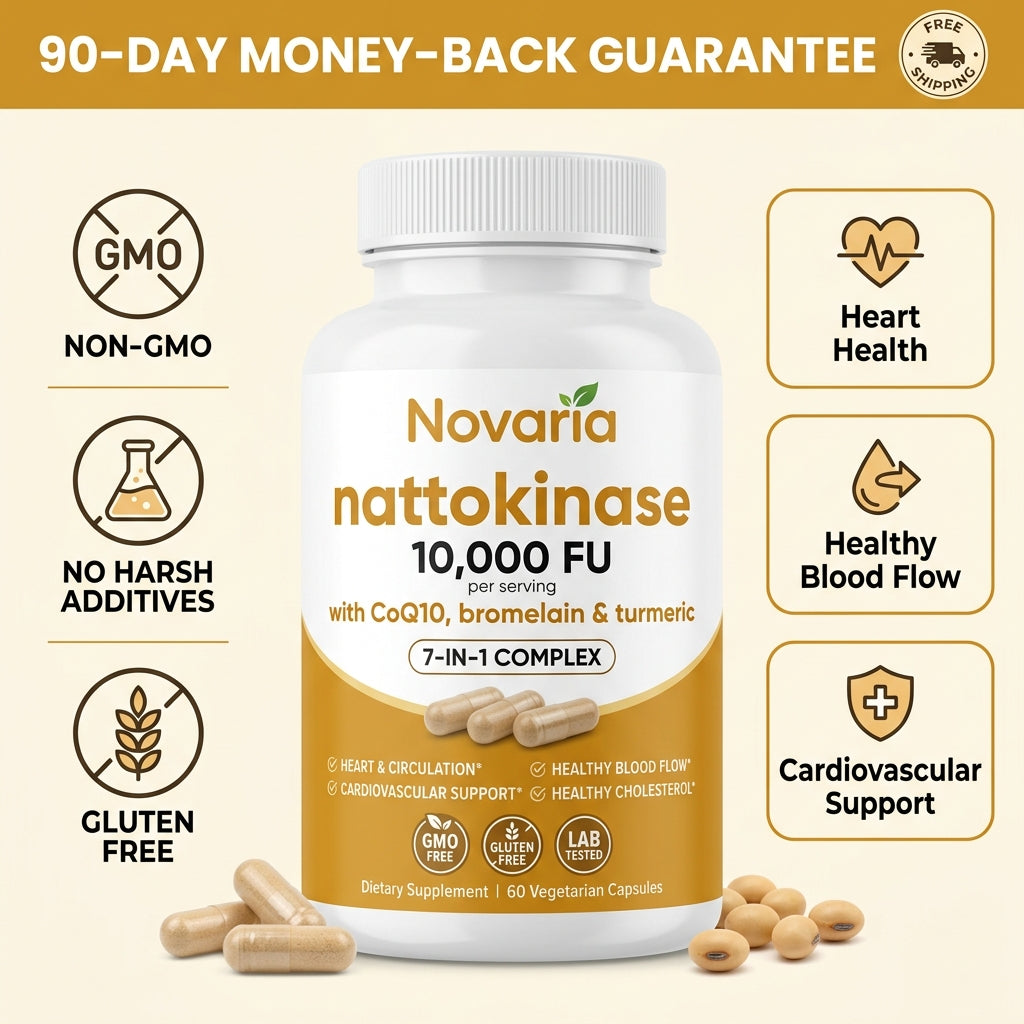
- Third-party tested — COA available on request
- Manufactured in an FDA-registered, cGMP-certified facility
- Full 10,000 FU in ONE capsule — no multi-capsule math
- 60 capsules per bottle — a full 2-month supply
What Happened In the First 90 Days
I want to be careful here. This is what I noticed. I am not making a medical claim. I am telling you what happened in my body, in my routine, and in the way I felt moving through my days.
Week 1–2: Nothing dramatic. I took one capsule with breakfast every morning. I stopped buying the beetroot powder. The garlic capsules stayed in the cabinet. I noticed I was sleeping slightly deeper, but I wasn’t sure if that was the capsule or the fact that I had stopped lying awake Googling ingredient lists.
Week 3–4: My hands were warm. I noticed because I was holding a mug of tea and realized I wasn’t holding it for the warmth the way I usually do. I was holding it because I wanted the tea. Small difference. But I noticed.
Week 6–8: I walked up the stairs at Tom’s office building — three flights — and I was talking when I reached the top. Not winded. Talking. That had not happened in over a year.
Week 10–12: I sat on the edge of the exam table at my doctor’s appointment. She took the reading. She looked at the number. She looked at me. She asked me what I had changed.
“I showed her the bottle. She read the back. She nodded once and said keep going. That is the first time a supplement has ever produced a conversation like that.”


Your Arteries Aren’t Waiting for You to Decide
- Fibrin is accumulating right now. Every day at the wrong dose — or the wrong supplement entirely — is another day it goes unaddressed.
- Nitric oxide production drops every year past forty. The flexibility your vessels had at thirty is not coming back on its own.
- Novaria is produced in limited batches. Clinical-grade nattokinase at the full 10,000 FU potency can’t be mass-manufactured. When a batch sells out, it’s gone until the next one clears.
- The Japanese didn’t wait for a diagnosis to start eating nattō. They made it part of breakfast. Every morning. For a thousand years.
I think about the woman I was six months ago. Standing in the supplement aisle. Reading labels. Choosing wrong. Doing the right things with the wrong tools.
If I could go back and hand her one bottle, it would be this one.
The Part Where I Almost Didn’t Order
I did the math instead. Three years of beetroot plus garlic plus CoQ10 plus fish oil. Roughly $84 a month. Over a thousand dollars a year on products that never addressed fibrin. Not once.
Novaria was $44.99. One capsule. The right enzyme. The right dose. The right tradition.
I ordered two bottles. One for me. One for Tom.
“I stopped checking the cuff at midnight. That was when I knew something had actually changed. Not the number. The fear. The fear was gone.”90-Day Money-Back Guarantee
Take Novaria every morning for 90 days. If it doesn’t earn its place in your routine, you get every cent back. No questions. No hoops. The guarantee exists because the dose is real, the tradition is real, and the science is real.
- Third-party tested · COA available
- FDA-registered · cGMP-certified facility
- Full 10,000 FU in one capsule · No math tricks
P.S. I ordered because of Japan. Because a thousand years of daily use meant more to me than any label on any bottle in any supplement aisle. One capsule. Every morning. The same enzyme their grandmothers ate, at the dose the research validated. That was enough.
P.P.S. Give it 90 days. The fibrin didn’t build up overnight and it won’t clear overnight. But the first sign — for me it was the warm hands, for Tom it was the stairs — will come sooner than you think. And when it does, you’ll know. Your body will tell you before the cuff does.